Expected Value in Poker: Pot Odds, EV & Decisions
Expected value in poker - pot odds, implied odds, EV of bluffs and folds. Worked hand examples showing how the maths translates into better decisions.
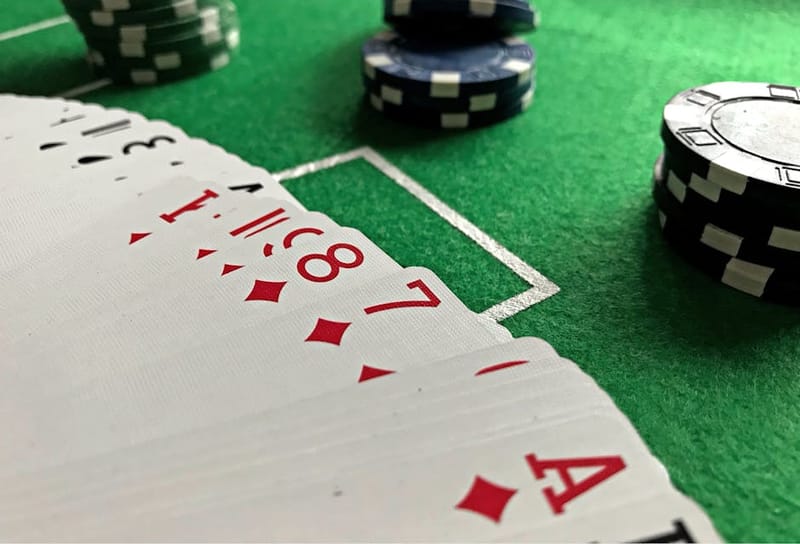
What does expected value mean at the poker table?
The same idea, applied to a single decision
Expected value at the table is the average outcome of a decision if you could repeat the same situation an infinite number of times. The formula is identical to the general one:
EV = (Probability of winning × Amount won) − (Probability of losing × Amount lost)
In poker, the "amounts" are chips and the "probabilities" come from the cards: the cards you see, the cards your opponent could have, and the cards still to come. Every meaningful decision in a poker hand - call, fold, bet, raise - has an EV. The decision with the highest EV is, by definition, the correct one.
The word "correct" here is unusually load-bearing. A correct (positive-EV) decision can lose money on the night. An incorrect (negative-EV) decision can win the pot. Variance - luck - masks the EV of any individual hand. The skill in poker is not seeing the future; it is making the highest-EV decision available, hand after hand, and trusting the maths to play out across enough hands.
The rest of this guide is the toolbox you use to compute EV in the situations that come up most often.
What are pot odds and why are they the cheapest EV calc?
When the maths makes the decision for you
Pot odds are the ratio of the cost of a call to the size of the pot you are calling into. They are the simplest possible EV calculation and the one most beginners learn first.
The setup: the pot is £100. Your opponent bets £50, making the pot £150. You have to put in £50 to win £150 (£100 already in the pot, plus their £50 bet). Your pot odds are 50:150, or 1:3 - for every £1 you risk, you stand to win £3.
To break even on a call, you need to win at least 25% of the time. The maths:
- Win 25% of the time, gain £150 → expected gain = £37.50
- Lose 75% of the time, lose £50 → expected loss = £37.50
- EV = £0
If your hand wins more than 25% of the time, the call is profitable. If it wins less than 25% of the time, the call is unprofitable.
The quick way to think about pot odds at the table:
| Pot odds | Bet to call | Pot before call | Break-even win rate |
|---|---|---|---|
| 1:1 | £50 | £50 | 50% |
| 1:2 | £50 | £100 | 33% |
| 1:3 | £50 | £150 | 25% |
| 1:4 | £50 | £200 | 20% |
| 1:5 | £50 | £250 | 17% |
The bigger the pot relative to the bet, the smaller the win rate you need to make calling profitable.
This is where common drawing situations get their famous heuristics. A flush draw on the flop has roughly nine outs (cards that complete it). The rule of "4 and 2" estimates your odds: nine outs × 4 ≈ 36% by the river, nine outs × 2 ≈ 18% by the turn. So with a flush draw on the flop, facing a half-pot bet (which gives you 1:3 pot odds, requiring 25% equity), the call is profitable by a comfortable margin if there is no further bet on the turn - exactly when you should consider implied odds.
What are implied odds in poker?
Why a -EV call can become a +EV decision
Pot odds only count the money currently in the pot. Implied odds add the money you can reasonably expect to win on later streets if you hit your hand.
The setup: you have an open-ended straight draw on the flop (8 outs, roughly 32% by the river). The pot is £20, your opponent bets £20. You need to call £20 to win £40, which gives you 1:2 pot odds and a 33% break-even point. Your raw equity is just below this threshold, so on a pure pot-odds basis the call is marginal-to-bad.
But your opponent has £200 left in their stack. If you hit your straight on the turn or river, they are likely to pay off another £40-60 with a good top pair. That £40-60 is implied money - money you will win, on average, when you hit, that the pot odds calculation does not currently see.
Factor it in:
- Win 33% of the time → gain £40 (current pot) + £40 average paid off later = £80 → expected gain = £26.40
- Lose 67% of the time → lose £20 → expected loss = £13.40
- EV = +£13.00
With implied odds, the marginal call becomes clearly profitable.
Implied odds are estimates, not guarantees. They depend on:
- Your opponent's stack size (no implied odds against an opponent who is all-in)
- How disguised your hand will be when you hit (a flush completes obviously; a backdoor straight does not)
- Your opponent's tendency to pay off second-best hands
- Position - implied odds are higher in position because you control the size of later pots
Good players adjust implied odds upward against loose, station-y opponents and downward against tight, fit-or-fold ones. Badly applied, implied odds become a self-justifying excuse to call too wide; well applied, they capture real expected money the pot odds do not.
What are reverse implied odds?
The trap that kills draws to second-best hands
Reverse implied odds are the mirror of implied odds: the money you will lose on later streets when you make a hand that is good enough to call with but not good enough to win the pot.
The classic case is a weak top pair on a coordinated board. You call the flop with top pair, weak kicker; the turn brings a possible flush; you call again because "the pot is too big to fold"; the river brings a possible straight; you call again. By showdown you have invested far more than the original pot odds suggested, and you are losing to your opponent's better top pair, made flush, or straight.
Reverse implied odds are why drawing to dominated hands (low pairs, weak suited connectors against a raise) is such a slow leak. The hand looks like it has equity. It does. But every time the equity "realises" into a made hand, you are about to lose more money - sometimes much more - to a hand that has you crushed.
The practical rules:
- Drawing to the nuts is excellent. When your draw makes the best possible hand, your implied odds are clean - you do not have to fear paying off a bigger hand.
- Drawing to non-nut hands is fine if the pot odds alone make it +EV. Discount implied odds and avoid building a big pot post-draw.
- Beware the "second-best" trap. Top pair weak kicker, second-nut flush against a turn-aggressive opponent, low straight on a paired board - these are situations where implied odds get inverted into reverse implied odds.
How do you calculate the EV of calling vs folding?
Putting the framework on a concrete decision
Let's walk through a complete EV calculation for a meaningful river decision.
The situation. You are heads-up on the river. You hold A♠ Q♠ on a board of K♠ 7♠ 4♥ 2♣ J♦. Your hand is ace-high - likely no good against any pair, but you have ace-high blocker value. The pot is £200. Your opponent bets £100 (a half-pot bet). You have to decide whether to call £100 to win £300.
Pot odds: 100:300, or 1:3. You need to win 25% of the time to break even.
Hand reading. From their pre-flop call, flop check-call, turn check-call, river bet, you assign them a range. Reasonable assumptions:
- 50% of the time they have a king (call your hand wins 0%)
- 25% of the time they have a missed flush draw or a busted hand (your ace-high beats them ~100%)
- 15% of the time they have a small pair (your ace-high loses ~100%)
- 10% of the time they have a weird value bet (KJ, JJ, two pair) (loses ~100%)
Your estimated equity against their range:
- 50% × 0% (lose to kings) = 0%
- 25% × 100% (beat the bluffs) = 25%
- 15% × 0% (lose to small pairs) = 0%
- 10% × 0% (lose to bigger value) = 0%
Total equity ≈ 25%.
EV of calling:
- 25% × £300 (the pot you win) = £75
- 75% × −£100 (the call you lose) = −£75
- EV = £0
Break even - the call is not profitable, but not a leak either.
EV of folding: £0 by definition. Folding closes the action with no further loss.
In this case, calling and folding are equivalent in expected value. Most experienced players would lean toward the fold, on the principle that the assumed bluff frequency (25%) is generous and the cost of being wrong about it is greater than the cost of folding marginally too tight.
The point of the exercise is not the specific numbers - they will always be estimates. The point is that the decision becomes structured: estimate the opponent's range, estimate your equity against it, compare the EV of calling against zero. Once you have done this calculation a hundred times, you start doing it instinctively at the table in seconds.
What is the EV of a bluff?
When your hand has zero equity, a bet still can
Bluffing flips the EV calculation. You have a hand that cannot win at showdown. Your only path to winning the pot is to make your opponent fold.
The framework:
Bluff EV = (Fold % × Pot won) − (Call % × Bluff cost)
The setup. The pot is £100. You bet £75 as a bluff. The required fold frequency to break even:
- Required fold % = bet ÷ (bet + pot won) = 75 ÷ (75 + 100) = 43%
If your opponent folds more than 43% of the time, the bluff is profitable. If they fold less than 43%, it is unprofitable.
The size of the bluff matters a lot:
| Bluff size | Pot before bluff | Required fold % to break even |
|---|---|---|
| 1/3 pot | £100 | 25% |
| 1/2 pot | £100 | 33% |
| 2/3 pot | £100 | 40% |
| Pot | £100 | 50% |
| 1.5x pot | £100 | 60% |
| 2x pot | £100 | 67% |
Smaller bluffs need fewer folds to be profitable. Bigger bluffs need more folds but win more when they succeed. Sizing your bluffs based on the actual fold frequency you expect is one of the highest-leverage applications of EV thinking in poker.
Where bluff EV most often goes wrong:
- Picking opponents who do not fold. A 40% fold frequency is unrealistic against most live recreational players, who tend to call far too wide on the river. Bluff sizes that work against tight regulars are −EV against calling stations.
- Bluffing into multiple opponents. The fold frequency required compounds - if each opponent calls 60% of the time, the chance both fold is 0.4 × 0.4 = 16%. Multi-way bluffs are almost always −EV.
- Bluffing without a coherent story. Your opponent's call frequency is higher when your line does not match a value-bet narrative. Bluffs work best when your previous actions in the hand could equally represent a value bet.
What is the EV of a value bet?
The mirror of bluffing - and where most money is made
Value betting is the everyday positive-EV action in a winning poker game. You have a hand likely to be best at showdown, your opponent has a worse hand they will pay off with, you bet, they call, you win more than they wanted to give you.
The framework:
Value bet EV = (Call % × Bet) − (Fold % × 0)
Unlike bluffs, the EV of a value bet is unambiguously positive whenever your hand has more equity than your opponent calls with. The questions are sizing and frequency, not whether to bet.
Sizing the value bet:
- Big value bets (75-100% pot) extract maximum value but only when the opponent's range is strong enough to call.
- Small value bets (33-50% pot) extract less per hand but get called by more of the opponent's range, especially weaker pairs that fold to a big bet.
- Bet for value when you can name the worse hands that call. If you cannot articulate three hand types your opponent will call with that you beat, the bet is at best break-even and at worst a thin bluff.
The 'thin' value bet - betting hands like top pair weak kicker on a draw-heavy river - is where many decent players leak EV. The bet is correct against opponents who pay off thinly; it is wrong against opponents who only call with bigger pairs and better. Adapting bet size and frequency to opponent type is the practical work.
Does EV work the same in tournaments and cash games?
Why ICM changes the maths
Almost everything above applies cleanly to cash games, where every chip has the same monetary value as every other chip. Tournament EV is more complex because the relationship between chips and money is non-linear.
In a tournament, doubling your stack does not double your equity in the prize pool. Late-game pay jumps mean a chip won is worth less than a chip lost - losing a flip near the bubble can knock you out for nothing, while winning the same flip only nudges you up the leaderboard. This is captured by the Independent Chip Model (ICM), which converts chip stacks into expected dollar/pound equity given the prize structure.
The practical consequence: marginal cash-game spots that are clearly +cEV (chip EV) become −$EV (dollar EV) under ICM pressure. The classic example is a flip for stacks on the bubble - calling all-in for 50% equity is +cEV (you risk x chips to win x chips, a wash in chip terms) but −$EV (you risk a likely cash for a small chance of doubling up).
For most players, the rule is simple: cash-game EV thinking applies in early-stage tournaments and deep-stack situations. ICM-aware EV thinking takes over in the late stages, on the bubble, and at final tables. If you are serious about tournament play, learn the basics of ICM after you are comfortable with cash-game EV.
Which biases distort EV thinking at the poker table?
Where the maths and the brain disagree
EV in poker is mathematically clean. The reason humans struggle to apply it is that several well-documented cognitive biases conspire to make us deviate from EV-optimal decisions.
The gambler's fallacy - the belief that random outcomes are "due" to balance out - leads players to chase losses ("I have lost five flips, the next one has to be mine") or play scared after a hot streak. Each hand is independent; previous results do not change current EV.
The sunk cost fallacy - the urge to keep investing because you have already invested - explains why so many players call rivers that the pot odds clearly say to fold. The chips already in the pot are not yours; the only question is the EV of the call you are about to make.
Loss aversion - feeling losses about twice as strongly as equivalent gains - makes players fold profitable calls because the £100 they might lose hurts more than the £200 they might win helps. EV does not weight losses more than gains; humans do.
Hindsight bias - the feeling that an outcome was "obvious" once it happens - leads players to second-guess EV-correct decisions that lost money. The river card you should have folded to was unknowable before it landed; the call was either +EV or −EV based on the information available at the time.
A healthy poker EV mindset is partly arithmetical (do the calculation) and partly behavioural (notice when these biases are pulling you off the maths).
How does EV sizing connect to bankroll management?
EV per hand vs survival across many hands
An individually +EV decision can still bust your bankroll if you size it too large relative to your total stack. This is the same insight behind the Kelly criterion for bet sizing - knowing your edge tells you the right direction; it does not tell you how much to risk.
For poker specifically:
- Cash-game bankroll is typically 20-40 buy-ins for the stake you play, depending on game type and your win rate. This is conservative enough that even substantial downswings (hundreds of buy-ins lost across a sample of thousands of hands is normal variance for many winning players) do not bust you.
- Tournament bankroll needs to be larger - often 100-200 buy-ins for serious play - because tournament variance is enormous. Even +EV tournament players regularly go 20-40 buy-ins between cashes.
- The maths translates EV per hand into long-run results, not per-session. Trust the EV; tolerate the variance.
If you find yourself making EV-correct decisions but going broke anyway, the problem is bankroll sizing, not the decisions themselves. Conversely, if you have an enormous bankroll but lose money long-term, the problem is your EV calculations.
What are the pros and cons of strict EV-based play?
What you gain, what it costs
What we liked
- Decisions become structured - every hand reduces to a small set of estimable numbers (pot odds, equity, opponent range)
- Tilt becomes harder - when your standard is 'did I make the +EV play?' rather than 'did I win?', a bad beat is just variance
- Bluff and value-bet sizing become principled rather than feel-based
- You stop chasing draws that do not have the pot odds and stop folding draws that do
- You start identifying −EV plays others make at the table - the source of most of your profit comes from their leaks, not your wizardry
- Long-run results align more closely with skill than with luck
Watch out for
- Calculations slow you down at first - expect to be the slowest player at the table while you build the skill
- Estimating opponent ranges is the hardest input and never feels precise - bad inputs make EV calculations feel fake until you trust the process
- Variance is brutal even with +EV play - large samples are required for the maths to surface above noise
- Live games sometimes punish strict EV play behaviourally - opponents adapt to predictable strategies
- You can over-rely on the maths and miss qualitative reads (a player's body language, table image, recent history)
- Tournament ICM adds a layer of complexity that pure cEV thinking misses - many players burn money by ignoring it
Putting It All Together
What to practise first
If you take one thing from this guide, it should be: structure every meaningful decision as an EV calculation, even when you are not sure of the inputs. The act of asking "what is my equity, what does the pot offer, what is the EV?" forces you to think clearly. Imprecise inputs that produce structured EV estimates beat precise gut feel that produces unstructured guesses.
A practical training sequence:
- Master pot odds. Memorise the break-even percentages for common bet sizes. Quote them in your head every time you face a bet.
- Learn the rule of 4 and 2 for converting outs to equity. Apply it on every flop where you are facing a bet with a draw.
- Add implied odds as a deliberate adjustment - never as a default justification for marginal calls.
- Estimate opponent ranges in big spots. Be specific: "He raised pre-flop, c-bet, checked turn, bet river - that range is mostly missed draws and weak made hands."
- Compute river EVs for difficult call/fold decisions in your own hands away from the table. After a session, review three or four decisions where you were unsure - work through the EV with notes, then check your conclusion against a solver if you have one.
- Connect EV to bankroll. Even +EV play needs adequate bankroll to survive variance - see our Kelly criterion sizing guide for the underlying maths.
The core EV concept is identical to the broader application we cover in expected value explained; poker is just where the calculations are constant and the consequences immediate. Once it becomes second nature at the table, you will find the same framework applies cleanly to investing decisions, business decisions, and most situations where outcomes are uncertain and you need to choose under risk.